

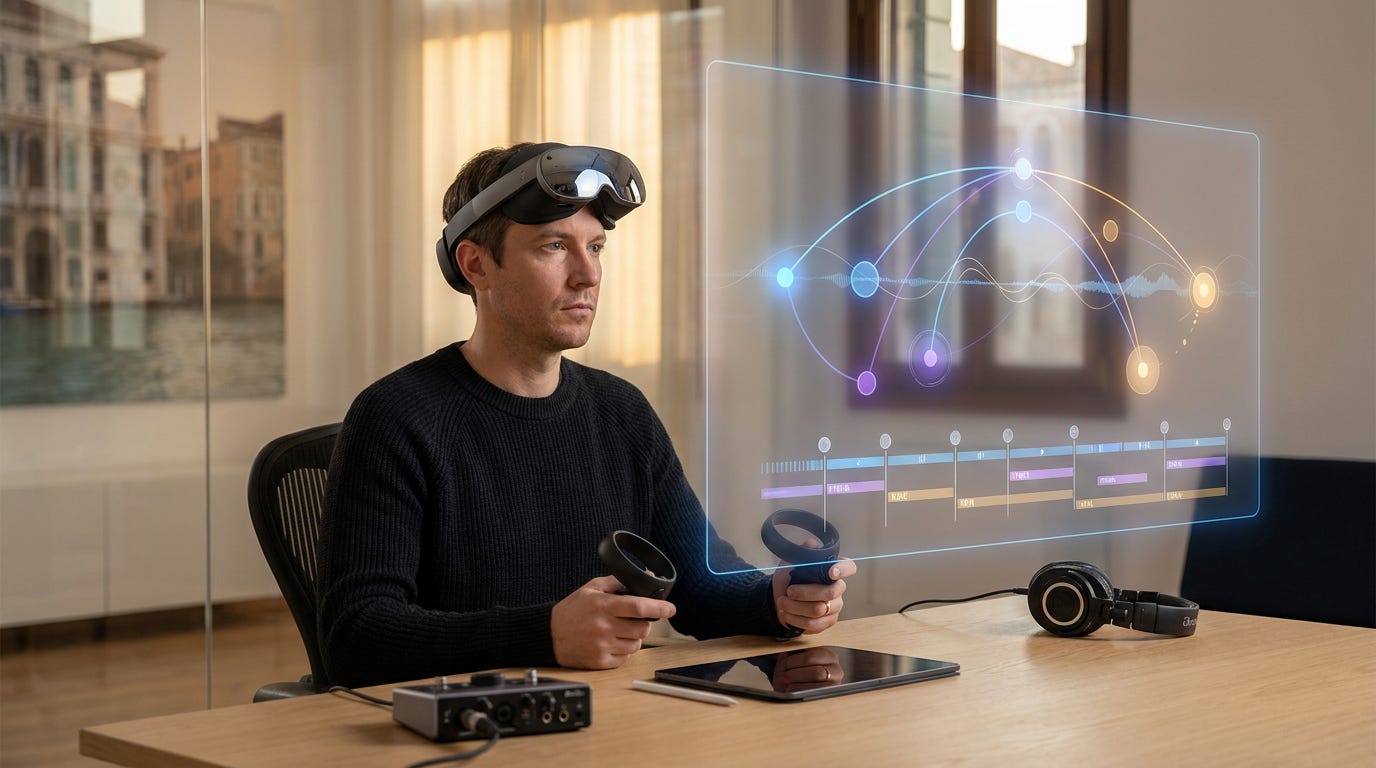
As three projects I’m involved (using EmotiTone, of course) will premiere at the Venice Biennale, I continue to refine the processes and adding new ones to make things even seamless and easier for anybody that would like to give it a try.
So, one feature direction I’m building in EmotiTone is the tool I wish I had a decade ago:
👉 Script → emotional map → scene-by-scene audio requirements.
Because “make it more emotional” is not a brief, it’s a delay.
A map forces specificity:
✅ Target state: what should this scene do to the body?
✅ Transition: what does it need to become next?
✅ Integration time: where does the nervous system need silence to catch up?
✅ Harmonic behavior: what tension/resolution rules are permitted?
✅ Identity thread: what must remain stable across scenes so it feels coherent?
Once those answers exist, music stops being decoration and becomes a repeatable system the narrative can rely on.
I’m working so that the AI helps with speed in the near future. But the real win is clarity: fewer moodboards, fewer wrong turns, and a workflow where intent is visible early. This is already happening, and it’s amazing.
One question:
Where are you currently asking sound to “add emotion” when what you actually need is a state transition plan? If you want to turn a script beat into an implementable emotional map, don’t hesitate to reach out.
Best wishes,
Billy.