Ecliptic Atlas: When Planets Become Resonance
On planetary “normal modes,” Frippertronics, and turning orbital physics into a cinematic album

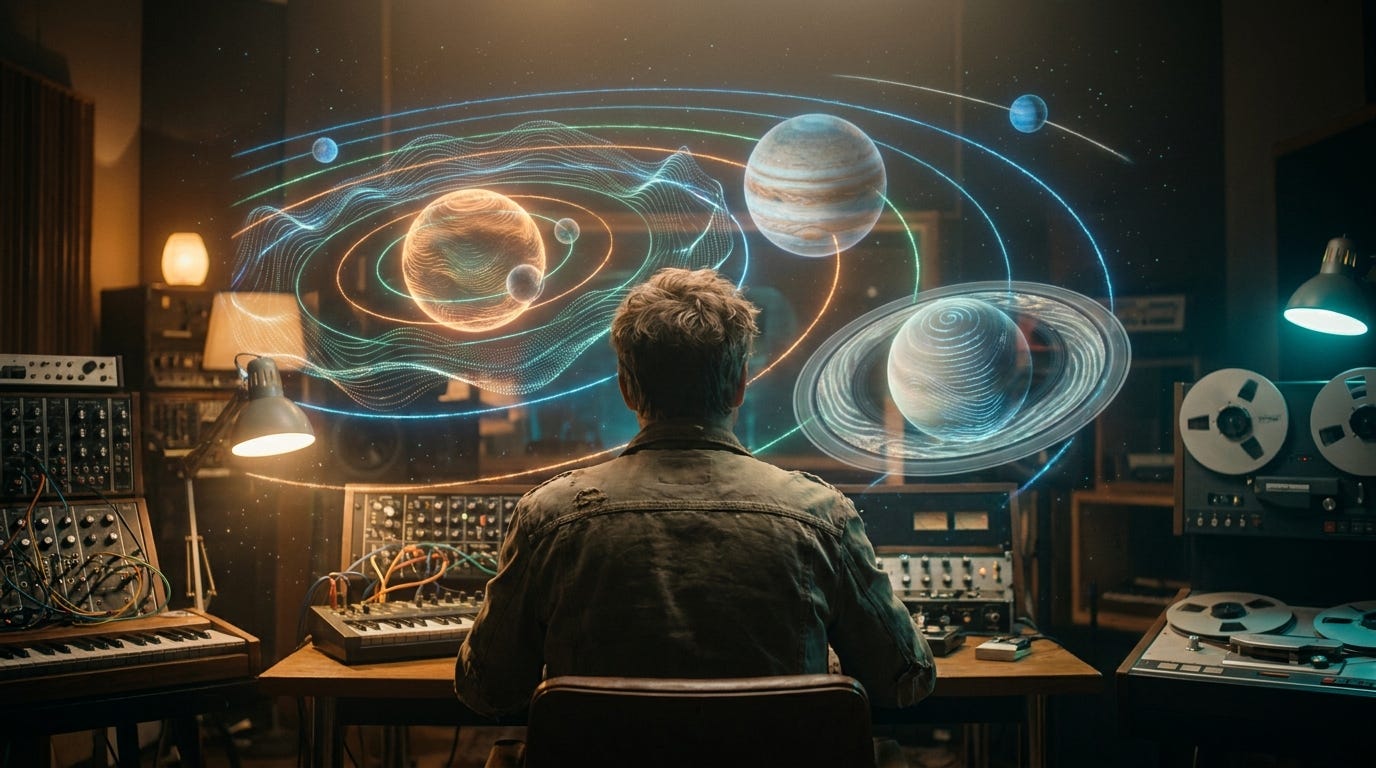
I used to think “frequency” was a music word.
Then you remember it’s a physics word first: any complex thing that can flex, compress, rotate, or slosh can carry its own natural oscillations (the same idea as a bell’s ring, just scaled up to absurd proportions).
We’ve seen evidence of that at planetary scale too. Juno’s gravity measurements have been used to infer normal-mode oscillations inside Jupiter (Nature Communications).
And with Saturn, it gets even more poetic: the rings can behave like a kind of seismograph, where wave patterns in the rings reflect oscillations within the planet (AGU Advances).
That idea hit me like a scene change: what if I treated the Solar System like an atlas, not of places, but of resonances?
So I made an album: Ecliptic Atlas: Ten Orbits + Three Shadows.

The backbone of each track is a steady frequency mapped to a Solar System body, something you can feel more than you can “hear as a note.”
But I didn’t want it to sound like a lab tone dressed up with reverb. I wanted it to behave like cinema.
So on top of those beds, I built layers using Frippertronics, Robert Fripp’s approach to looping where a delay/tape-loop system keeps re-recording the signal so harmonies accumulate, blur, and slowly decay.
It’s not “a loop you play over.” It’s a memory system you play into, where the music keeps rewriting itself.
That’s the hinge for the whole project: the frequency stays as the underlying coordinate, and the musical layers become the terrain drawn over it, with motion, gravity, weather, distance, shadow.
The result is a record that’s meant to feel like a map you can stand inside.
Ecliptic Atlas: Ten Orbits + Three Shadows is out now on all music platforms.
If you listen, I’m curious: does it read to you as “space,” or does it read as something closer—like inner geography wearing a cosmic mask?
Best wishes,
Billy.